Root cause analysis that checks the fix held.
Cadence Resolve coaches warehouse and logistics teams through a real investigation, holds every corrective action to an owner and a date, and then asks whether the problem actually stopped. The loop closes on evidence, not on a ticket being marked done.
- 300+ automated tests
- Tenant isolated data
- No training on your data
- UK built and run
| Stage | In this example | Leads to |
|---|---|---|
| Incident | Incident: repeat mispicks on the night shift | Hypothesis: picker was careless; Hypothesis: look-alike stock sits together; Hypothesis: no bin check at the scan |
| Hypothesis | Hypothesis: picker was careless (discarded, the evidence did not support it) | The case closes, and the check reopens it if the problem returns. |
| Hypothesis | Hypothesis: look-alike stock sits together | Verified cause: slotting puts look-alike SKUs side by side |
| Hypothesis | Hypothesis: no bin check at the scan | Verified cause: the system asks for no confirmation |
| Verified cause | Verified cause: slotting puts look-alike SKUs side by side | Action: reslot the fast movers, owner and date set |
| Verified cause | Verified cause: the system asks for no confirmation | Action: scan to confirm the bin on look-alikes |
| Corrective action | Action: reslot the fast movers, owner and date set | Effectiveness check: did it hold? |
| Corrective action | Action: scan to confirm the bin on look-alikes | Effectiveness check: did it hold? |
| Effectiveness check | Effectiveness check: did it hold? | The case closes, and the check reopens it if the problem returns. |
Closing the ticket is not the same as fixing the problem.
How it usually goes
- The loudest theory in the room wins, and it is usually a person.
- The action list says "retrain the team" with no name and no date against it.
- The investigation lives in a spreadsheet nobody opens again.
- Nobody checks in six weeks, so the same failure comes back next quarter and is treated as new.
What we hold you to
- A cause you can change: slotting, a system prompt, a standard, a layout.
- An action with an owner, a due date and a date to check whether it worked.
- A close gate that refuses a case missing any of those.
- A verdict on the check date, and if it recurred, the case reopens as an 8D with the history attached.
Walk through one investigation, start to signed A3.
- Incident
- Hypothesis
- Verified cause
- Corrective action
- Effectiveness check
Describe the incident
One sentence is enough to start. The coach picks a method and tells you why it picked it, and you can override it.
YouThird mispick this month on the aisle 7 fast movers, night shift.
CoachStarting a 5-Why: one incident, one chain of causes. Switch to a fishbone if more than one factor appears.
Illustration of the coaching pattern. The example is fictional.
Get past the first answer
Blame is the fastest wrong answer in the room. The coach keeps asking until the answer is something you can change.
YouThe picker was careless.
CoachWhat made the mistake possible? A careful person on that shift, on that aisle, with that screen: could they still have picked the wrong bin?
YouProbably, the two SKUs look identical and sit next to each other.
CoachThat is a slotting cause, not a person cause. Record it?
Illustration of the coaching pattern. The example is fictional.
Assign an action that will hold
Every action needs an owner, a due date and a date to check whether it actually worked. The close gate will not let a case shut without them.
YouReslot aisle 7 and add a scan confirmation.
CoachWho owns it, by when, and when should we check whether it held?
Illustration of the coaching pattern. The example is fictional.
Check it held
On the check date the question waits on the actions board, and an owner picked from your team is emailed it too. If the problem came back, the case reopens as an 8D with the history attached.
ResolveFour weeks on: has the mispick problem stayed fixed, or has it come back?
YouStayed fixed.
ResolveRecorded. The A3 now shows the fix held, with the date the verdict was given.
Illustration of the coaching pattern. The example is fictional.
Hand over the A3
One page: the why-chain, the fishbone, the actions, the verdict and a sign-off block. This is the artifact your boss reads.
ResolveA3 ready: problem, analysis, actions, verification, sign-off.
Illustration of the coaching pattern. The example is fictional.
In the product. Example workspace, fictional data.
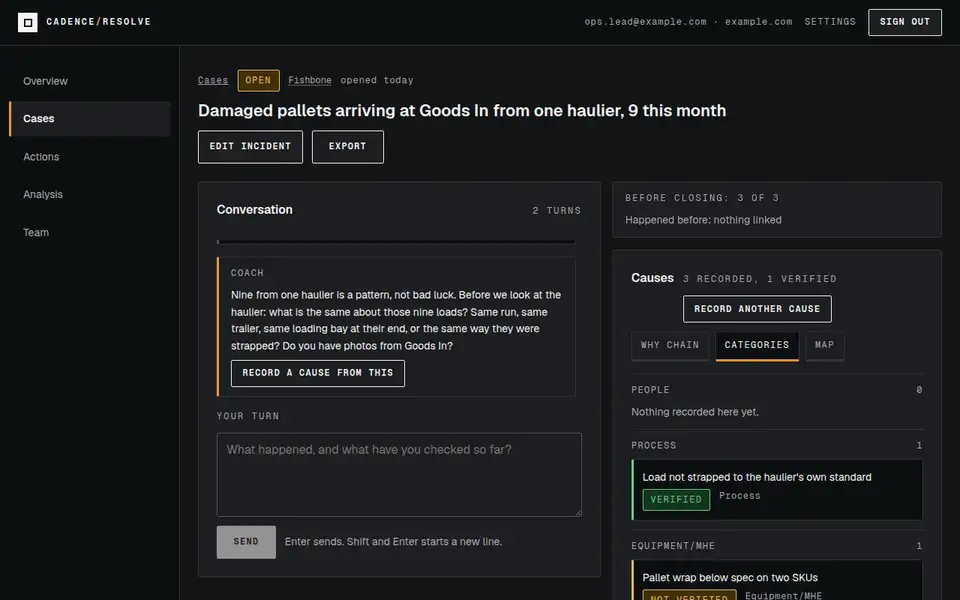
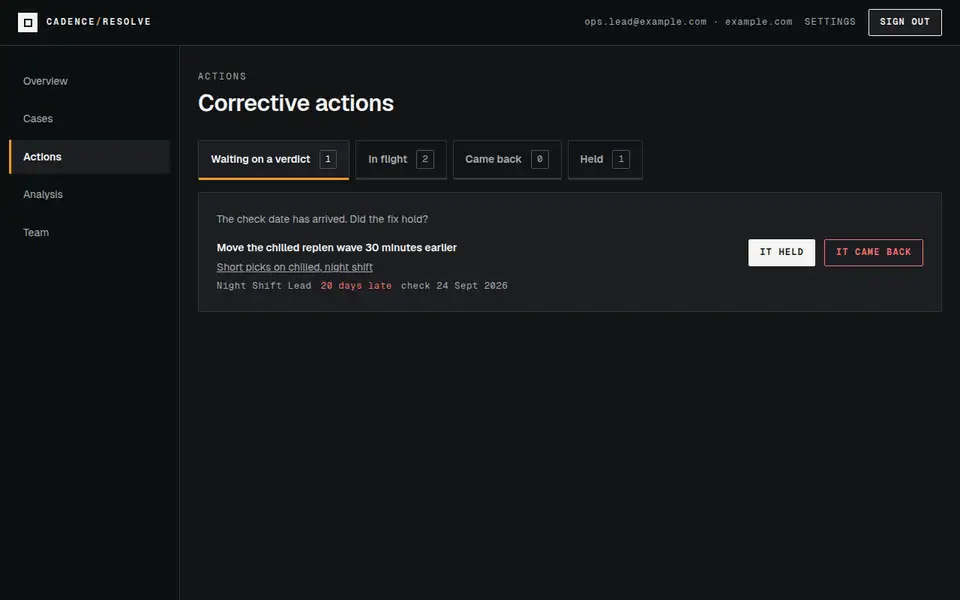
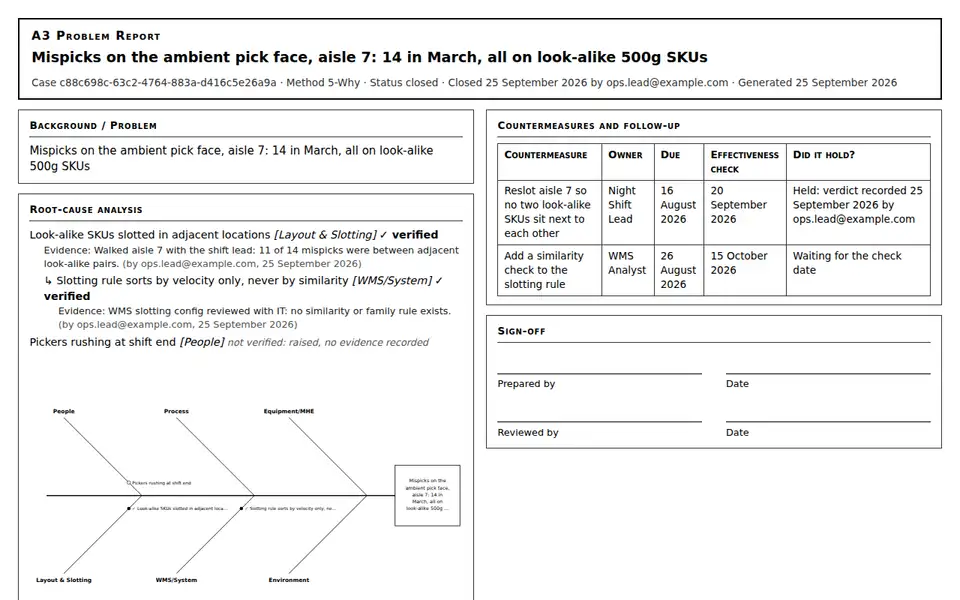
One investigation, whichever method it turns out to need.
The method is not a menu you pick from at the start and regret later. It follows the evidence, the coach suggests a change when the shape of the problem changes, and a person makes the call.
- Incident
- Hypothesis
- Verified cause
- Corrective action
- Effectiveness check
5-Why
The chain persists as a tree, so the fifth why is attached to the fourth rather than living in someone's notebook.
Fishbone
Causes are grouped by People, Process, Equipment, Layout and slotting, WMS and system, and Environment. The coach suggests the switch when a second category appears.
A3
Not a separate exercise: the A3 assembles itself from the investigation you already did.
8D
The eight disciplines in order, with interim containment as a gate. A case cannot close until containment is recorded.
The A3 is the point. Everything else assembles it.
An A3 is what survives the meeting. This one is generated by the product from a worked example, using the same code that prints yours: the why-chain tree, the fishbone, the actions with their verdicts and a sign-off block.
The example uses a fictional site and a fictional incident. It is not a customer's investigation.
Start on your own, or have us set it up.
£149per site per month, 1 site, up to 10 people
Start with a 14-day trial. No card needed. See the full pricing.
A paid 30 day pilot on one site.
£1,500 to £3,000one site, 30 days, invoiced once
- One site, up to five investigators, three real investigations run end to end.
- Your workspace, isolated from every other tenant, that only people your admin invites can sign in to.
- A working session to set it up, then coaching by email while your team uses it.
- The A3, fishbone and change-plan prints for every case you run, yours to keep.
What we need from you
- One named owner on your side who can pick the three investigations.
- Investigators who will type what actually happened, not a tidy version of it.
- Half an hour at the end to tell us what was useful and what was not.
What happens after the 30 days
- If it earns its place, the ongoing price is £500 to £1,000 per site per month.
- If it does not, you owe nothing further. We export your data and delete the workspace.
- Either way the prints you produced during the pilot are yours.
Your investigations are your data.
One tenant per company
Every query is scoped to your tenant, and cross-tenant isolation is covered by the automated test suite that runs on every change.
No training on your data
Coaching turns go to Anthropic's API under commercial terms that exclude training on API data. Nothing you write trains a model.
Nobody joins uninvited
A single-use link to your work email. Only addresses your admin invites can sign in, so nobody else can reach the workspace, even on your own domain.
Export any time, then purge
An admin downloads the whole workspace from Settings whenever they like. Ask, and we delete it. Coaching conversations on closed cases age out automatically after a year.
John Marston
Founder, Cadence Standard. Twenty years running and improving FMCG manufacturing and distribution operations, from machine operator to Day Operations Manager at Carlsberg UK and Operations Manager and Head of Lean UK at Asahi UK, and since then leading continuous improvement and warehouse transformation in distribution. Lean Six Sigma Green Belt. Resolve is the root-cause coaching he wanted on every shift he ran.
The things buyers actually ask.
How much work is this for my team?
What happens to what we type into it?
Does the AI decide anything?
Is our data used to train models?
Who can see our investigations?
Can we get our data out?
What if we want to stop?
Why is the pilot paid?
If one problem keeps coming back, start with that one.
Applications take about five minutes and go straight to us. We take a small number of pilots at a time, so tell us the problem you would point it at. After the pilot the ongoing price is £500 to £1,000 per site per month. Applying commits you to nothing.